

This is part of a series of posts in partnership with the American Indian Cultural District to promote and document intangible and tangible American Indian cultural heritage in San Francisco.
A Queen Anne-style home on Alamo Square, built in 1899, was once the location of the Friendship House Association of American Indians, the oldest social service agency in the United States run by and for American Indians. In 1963, 818 Steiner Street was sold to the Christian Reform Church. Using the name “Friendship House”, it became a safe haven for the growing urban Indian community in San Francisco, with a drop-in center that helped Native people find affordable housing, employment, and develop urban survival skills.


In 1973, the American Indian community organized and assumed control of the drop-in agency, incorporating as a 501(c)(3) non-profit named Friendship House Association of American Indians, Inc., of San Francisco.

Friendship House’s programs have evolved to serve men, women, expectant mothers, and youth. Their substance abuse recovery and prevention programs, as well as several community-wide programs, are built upon American Indian knowledge systems that reinforce the cultural identity of their clients. For example, treatment and recovery at Friendship House includes prayer, healing ceremonies, talking circles and a sweat lodge.
In 1982, Friendship House moved to the Mission District, and 818 Steiner was purchased by the St. Anthony Foundation for a halfway house and work program for young men (in 1985, San Francisco Heritage assisted in the rehabilitation of the home for St. Anthony’s through its Preservation Loan Program. See p. 3 of this SF Heritage News issue). Friendship House is today located at 56 Julian Avenue, within the American Indian Cultural District. Along with the Native American Health Center and Indian Education Program, Friendship House represents some of the integral American Indian services that operate within the District.
Until her passing in 2021, Friendship House was led by Helen Devore Waukazoo (Navajo), who co-founded, developed, and built the agency over the past fifty-eight years. A survivor of the federal Indian boarding school system, Helen was one of thousands of American Indians to be relocated to San Francisco in the 1950s under the Federal Termination Act with false promises of housing and work. She helped to found Friendship House as a volunteer at 818 Steiner and dedicated the rest of her life Native healing, empowerment, and visibility. This excerpt, from a recent tribute on Friendship House’s website, speaks to Helen’s important legacy:
“Helen taught and showed us the Way. She both inspired and challenged us to not only continue the healing of our people, but to grow and deepen that healing. To do this, she envisioned The Village, a sacred physical place that Indian people could call “home.”
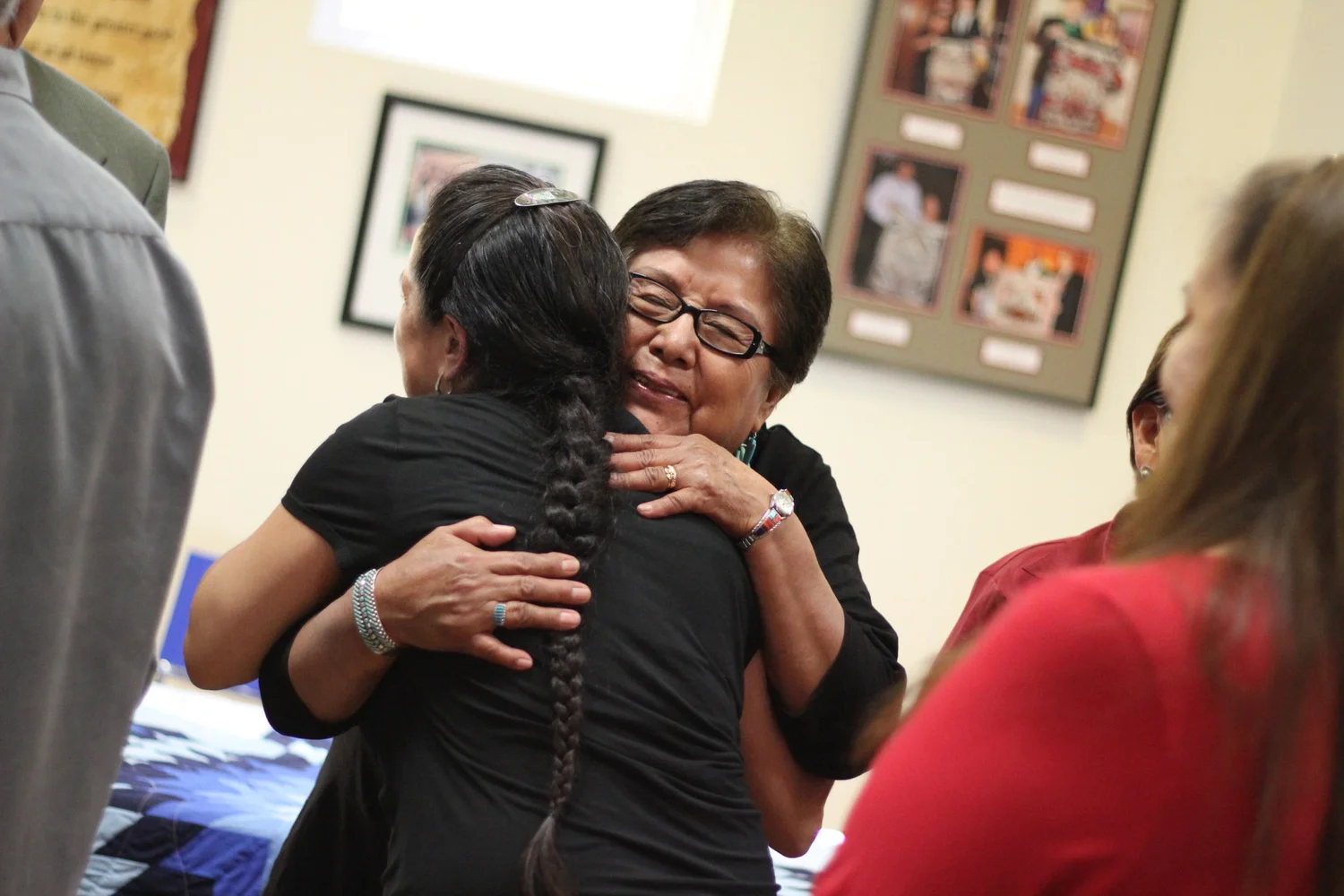
Her husband Martin Waukazoo (Lakota), who assumed leadership of Friendship House after Helen’s passing, spoke to the Navajo Times about the heart of Helen’s work at the organization:
“It wasn’t just a recovery program from alcoholism and drug addiction, it was a recovery of self. It was a recovery of family, your traditional ways, your culture, of who you are.”
Helen always envisioned a sacred physical place that Indian people could call “home.” Today, Friendship House, the NAHC, and Native and community supporters are embarking on an exciting new building development at the heart of the AICD called the Village SF. Located next to Friendship House’s current headquarters on Julian Avenue, this project is more than a building: it is a commitment to revitalizing and supporting Native American communities in the heart of San Francisco, and will serve as an important hub for Native access and healing for San Francisco and beyond.
To read more about Helen’s story and her vision, visit this page. To learn more about Friendship House’s history and programs, and to donate to support their work, visit their website at friendshiphousehealing.org.


